MyFitnessPal vs Cronometer 2026 — Which Calorie Tracker Wins?
MyFitnessPal vs Cronometer is the classic calorie-tracker face-off: the biggest database against the most accurate one. We break down database, accuracy, macros, price, and which fits you — plus the free option that beats both on value.
Quick Verdict
Choose MyFitnessPal if your priority is speed and breadth — the biggest database, the best packaged-food and restaurant coverage, and integrations with Garmin, Fitbit and Apple Health. Choose Cronometer if your priority is accuracy and nutrition depth — verified data, 80+ micronutrients, and full macros free.
But there's a catch most comparisons skip: MyFitnessPal now paywalls macro tracking, and neither app does anything to keep you logging. If you want Cronometer's free macros and MyFitnessPal's database breadth — plus a habit system — that's the gap NutriBalance fills.
MyFitnessPal wins on database size and convenience; Cronometer wins on accuracy and free macros — and the real differentiator between them in 2026 is that MyFitnessPal makes you pay for macros while Cronometer doesn't.
MyFitnessPal vs Cronometer — Side by Side
| Feature | MyFitnessPal | Cronometer |
|---|---|---|
| Food database size | 14M+ (largest) | ~1.1M (curated) |
| Data accuracy | ~ Variable (user-submitted) | ✓ Verified (USDA/NCCDB) |
| Macros on free tier | ✗ Premium only | ✓ Free |
| Micronutrients tracked | ~ Limited | ✓ 80+ free |
| Barcode scanner | ✓ Best coverage | ✓ Decent |
| Restaurant coverage | ✓ Excellent | ~ Weaker |
| Wearable sync | ✓ Garmin/Fitbit/Apple | ✓ Garmin/Fitbit/Apple |
| Gamification / streaks | ✗ | ✗ |
| Ads on free tier | ✗ Heavy ads | ✓ Minimal |
| Premium price | $19.99/month | ~$8.99/month (Gold) |
Food Database & Accuracy
This is the core trade-off. MyFitnessPal has the largest food database in the world at 14M+ entries — almost anything you scan or search is in there, including obscure packaged foods and restaurant items. The downside is that most entries are user-submitted, so you'll find duplicates and the occasional wrong value; you learn to pick the verified-looking entries.
Cronometer takes the opposite approach: a smaller, curated database built from authoritative sources like the USDA and NCCDB. Entries are accurate and consistent, and it's the only one of the two that tracks 80+ micronutrients (vitamins, minerals, amino acids) for free. The trade-off is breadth — packaged and restaurant foods are less complete, so you'll do more manual entry.
In short: MyFitnessPal optimises for "is it in there?", Cronometer optimises for "is it correct?".
Price & the Free Tier
This is where the comparison has shifted most. MyFitnessPal moved macro tracking — protein, carbs and fat in grams — behind its Premium plan at $19.99/month. On the free tier you essentially get calorie counting with ads. Cronometer, by contrast, keeps calories, macros, and 80+ micronutrients free; its Gold tier (~$8.99/month) only adds conveniences like custom charts and a fasting timer.
So if budget matters and you want macros, Cronometer is the clear winner on the free tier. MyFitnessPal only justifies its price if you specifically need its database breadth and integrations.
MyFitnessPal — Strengths & Weaknesses
Strengths
- Largest food database (14M+)
- Best restaurant and packaged-food coverage
- Best barcode scanner
- Wide integrations (Garmin, Fitbit, Apple Health)
Weaknesses
- Macros paywalled ($19.99/month)
- Variable data quality (user-submitted)
- Heavy ads on free tier
- No habit or streak system
Cronometer — Strengths & Weaknesses
Strengths
- Most accurate, verified database
- 80+ micronutrients free
- Full macros free
- Minimal ads
Weaknesses
- Smaller packaged/restaurant coverage
- More clinical, slower UI
- No habit or streak system
- No home screen widget on free tier
The Third Option Most People Miss
The MyFitnessPal vs Cronometer debate has a blind spot: both are logging utilities with no retention design, and one of them now charges for macros. If your real problem is staying consistent — the reason most people quit calorie tracking by week three — neither app helps.
NutriBalance (Paid, 14-Day Trial)
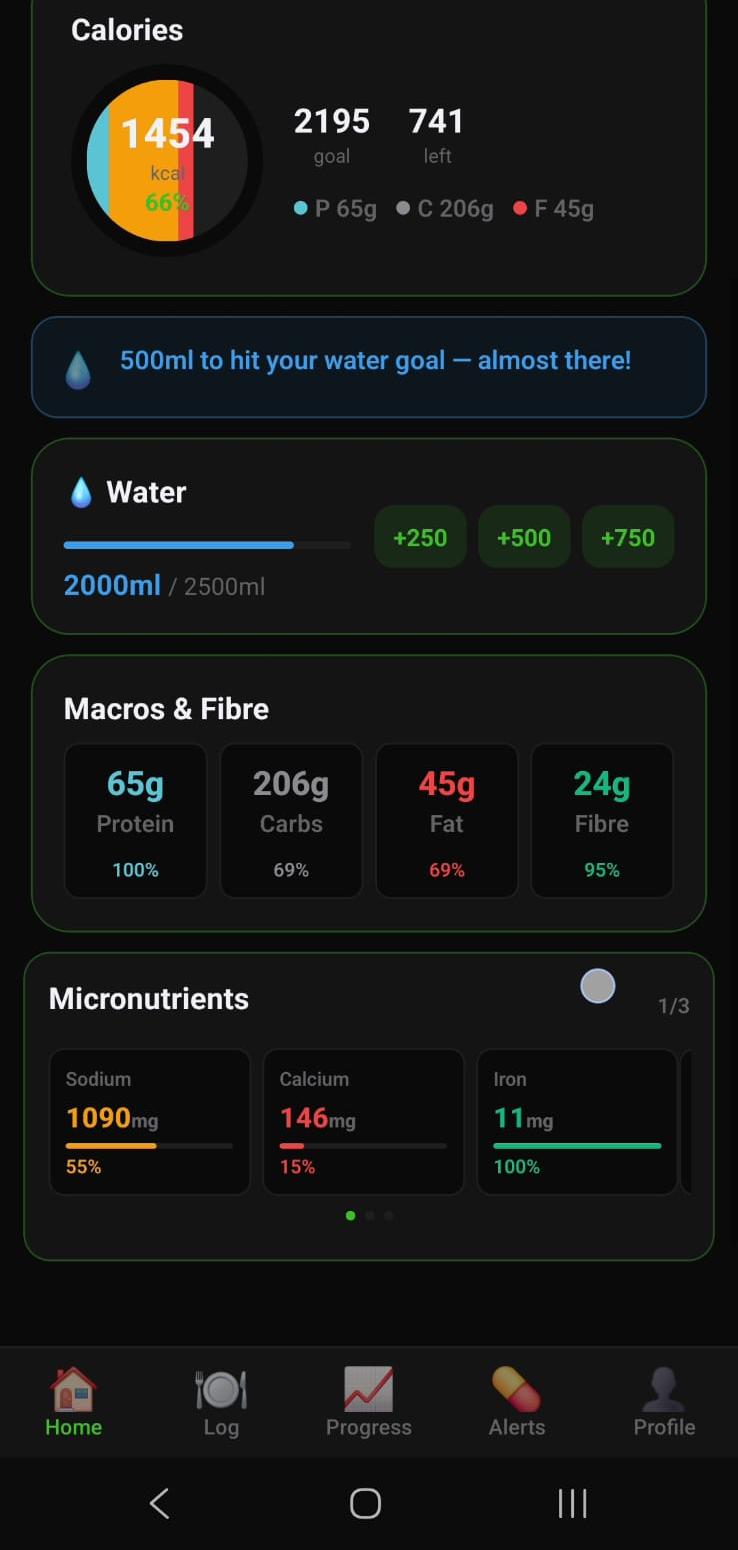
NutriBalance combines the things people pick MyFitnessPal and Cronometer for, then adds what both lack. You get full macro tracking included (like Cronometer's free approach, unlike MyFitnessPal's paywall), broad packaged-food and restaurant coverage with a 7M+ barcode database (like MyFitnessPal), and an AI food-label scanner — plus a full gamification system (streaks, weekly leagues, daily missions, 40+ achievements) and a free Android home-screen widget that neither competitor offers. It's ad-free on every tier, $12.99 AUD/month or $69.99 AUD/year, with a 14-day free trial (card required, auto-converts to paid).
Pros
- Free macros + broad database — best of both
- AI food-label scanner
- Streaks, leagues, achievements — keeps you logging
- Free home screen widget
- No ads; premium ≈ $8.49/month
Cons
- Fewer micronutrients than Cronometer
- Newer, smaller community than MyFitnessPal
- No Garmin/Fitbit sync yet
MyFitnessPal vs Cronometer: The Bottom Line
Pick MyFitnessPal for database breadth and integrations (if you'll pay for macros). Pick Cronometer for accuracy and free micronutrients. Or pick NutriBalance for macros (included, unlike MyFitnessPal), a broad database, and the gamified habit loop neither legacy app has — $12.99 AUD/month after a 14-day free trial.
Try free for 14 days — Android Try free for 14 days — iOS